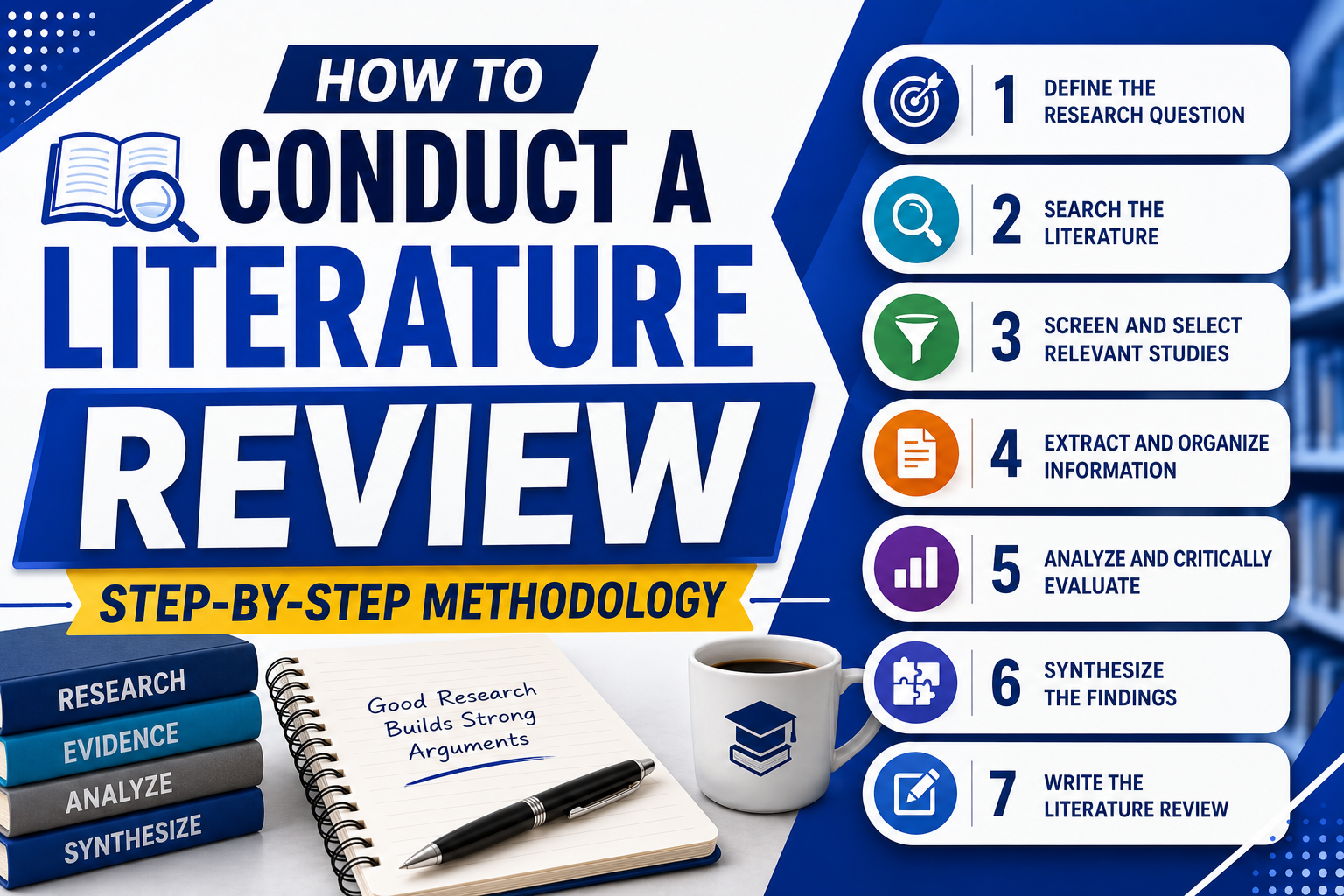
How to Conduct a Literature Review: Step-by-Step Methodology
Understanding the Purpose of a Academic Literature Review
A literature review is far more than a casual summary of existing publications. It is a critical, systematic synthesis of scholarly literature within a given field of study. Whether written as a standalone review article or as the foundational second chapter of a master's thesis or doctoral dissertation, a well-executed literature review maps the current state of knowledge, evaluates key theoretical frameworks, exposes methodological strengths and weaknesses, and pinpoints unaddressed research gaps that your study aims to fill.
Without a rigorous literature review, academic research risks duplicating previously published findings, relying on flawed methodologies, or lacking theoretical grounding. This step-by-step guide provides scholars with a structured framework for searching academic databases, evaluating peer-reviewed literature, synthesizing findings conceptually, and crafting a compelling narrative.
Phase 1: Formulating Precise Research Questions & Scope
Before entering academic databases, define a sharp research question. A broad topic like "online learning" yields millions of results, whereas a precise question like "How does synchronous video instruction affect student engagement in undergraduate STEM courses?" provides clear boundaries for your search.
The PICO and SPIDER Search Frameworks
Use established structural models to define your literature search scope:
- PICO Framework (Health & Sciences): Population, Intervention, Comparison, Outcome.
- SPIDER Framework (Qualitative & Social Sciences): Sample, Phenomenon of Interest, Design, Evaluation, Research type.
Phase 2: Comprehensive Database Search Strategies
Thorough literature reviews require systematic searches across multiple reputable academic databases, such as JSTOR, Web of Science, Scopus, PubMed, IEEE Xplore, and Google Scholar.
Mastering Boolean Operators & Search Syntax
Maximize search efficiency by combining Boolean operators and wildcard characters:
Boolean Query Construction:
("higher education" OR "university students")
AND ("active learning" OR "flipped classroom")
AND ("academic performance" OR "retention rate")
NOT ("k-12")
- AND: Narrows results by requiring all specified keywords to be present.
- OR: Broadens search to include synonyms or related terms.
- NOT: Excludes irrelevant subject areas.
- Truncation (*): Captures word variations (e.g.,
educat*retrieves education, educational, educator).
Phase 3: Critical Evaluation & Screening
Not all published articles carry equal academic weight. Evaluate retrieved papers against strict inclusion and exclusion criteria:
- Source Authority: Prioritize peer-reviewed journal articles, academic monographs, and official research reports over opinion pieces or unverified blog articles.
- Methodological Rigor: Inspect sample sizes, control mechanisms, validity indicators, and analytical techniques.
- Currency vs. Historical Significance: Balance seminal landmark studies (foundational works establishing core theories) with recent research published within the past 3 to 5 years.
Phase 4: Synthesis & Thematic Mapping
The most common error in student literature reviews is writing an "annotated bibliography" disguised as a review—summarizing paper A, then paper B, then paper C sequentially. A strong review synthesizes literature *thematically*, grouping studies by common themes, theoretical frameworks, or methodological approaches.
Creating a Literature Synthesis Matrix
Organize your reading using a synthesis table before drafting:
Synthesis Matrix Layout:
-----------------------------------------------------------------------------------------
Author & Year   Sample / Setting   Theoretical Lens   Key Findings        Identified Gaps
-----------------------------------------------------------------------------------------
Chen (2022)     N=450 Undergrads   Cognitive Load     Flipped models +14% Lacks long-term
                                   Theory             quiz scores         retention data
Miller (2024)   Qualitative (n=20) Self-Determination Intrinsic drive     Small sample size,
                                   Theory             increases focus     urban setting only
-----------------------------------------------------------------------------------------
Phase 5: Organizational Structures for Writing
Structure your literature review using one of four analytical frameworks:
- Thematic Structure: Organized around key themes, sub-topics, or theoretical debates. (Most common and effective approach).
- Chronological Structure: Traces the historical evolution of a research topic over time. Avoid simple chronological listing without critical analysis.
- Methodological Structure: Compares research outcomes based on differing methods (e.g., comparing qualitative case study findings against quantitative survey data).
- Theoretical Structure: Focuses on how different theoretical models explain a single research phenomenon.
Identifying Research Gaps & Justifying Your Study
The ultimate goal of your literature review is to justify *why* your study needs to be conducted. Conclude your review by highlighting explicit gaps in the existing body of knowledge:
- Population Gap: Existing research has not examined this specific demographic or geographical setting.
- Methodological Gap: Previous studies relied exclusively on quantitative surveys; a qualitative exploration is required.
- Contradictory Findings Gap: Published studies offer conflicting results, requiring a rigorous clarifying investigation.
Summary & Writing Checklist
A stellar literature review connects existing scholarly research into a coherent, thematic narrative that logically leads to your own research project. Follow this step-by-step framework to ensure your academic writing demonstrates depth, critical evaluation, and theoretical rigor.
Advanced Search Optimization & Citation Management Tools
Managing hundreds of scholarly articles, journal PDFs, and bib citations can become chaotic without dedicated reference management software. Professional academic researchers utilize platforms such as Zotero, Mendeley, or EndNote to organize literature libraries automatically, generate in-text citations, and format reference lists across APA, MLA, and Chicago styles.
Automating Search Alerts & Citation Chaining
- Forward Citation Chaining: Identify landmark seminal papers and use Google Scholar or Scopus to examine all recent articles that have cited those landmark studies.
- Backward Citation Chaining: Review the reference lists of recent high-impact review papers to locate overlooked primary sources.
- Automated Database Alerts: Set up automated RSS feeds or email alerts in databases like Web of Science or PubMed to receive notifications whenever new papers matching your Boolean query are published.
Synthesizing Theoretical & Conceptual Frameworks
A superior literature review goes beyond summarizing findings by establishing a robust theoretical framework. Identify the core concepts, underlying mechanisms, and theoretical assumptions that govern your research area. Clearly distinguish between theoretical frameworks (derived from established academic theories) and conceptual frameworks (diagrammatic models constructed by the researcher to illustrate relationships between key variables).
Critical Evaluation Frameworks: Assessing Methodological Quality
When conducting a literature review, graduate scholars must critically appraise every retrieved article rather than accepting published claims at face value. Evaluate empirical papers using standardized critical appraisal checklists (such as the CASP Qualitative Checklist or the JBI Critical Appraisal Tools). Inspect whether authors clearly defined target populations, controlled for confounding variables, selected valid measurement scales, and acknowledged potential conflicts of interest or funding biases.
Writing Style, Academic Tone & Synthesis Techniques
Writing a successful literature review requires maintaining an active, authoritative academic tone. Avoid passive listing of author summaries. Instead of writing "Smith (2020) studied X. Jones (2021) studied Y," use thematic synthesis markers: "While early empirical studies focused exclusively on individual cognitive factors (Smith, 2020), recent scholarship has expanded to evaluate broader socio-cultural influences (Jones, 2021; Williams et al., 2023)." This approach highlights your ability to analyze complex academic conversations and synthesize multiple perspectives effortlessly.
Synthesizing Theoretical Models & Developing Conceptual Frameworks
A literature review must systematically link empirical findings to underlying theoretical models. When analyzing published articles, document the specific theoretical frameworks employed by previous investigators—such as Cognitive Load Theory, Self-Determination Theory, or Social Constructivism. Compare how different theoretical lenses yield varying interpretations of the exact same academic phenomenon.
Furthermore, use the literature review to develop your study's conceptual framework. A conceptual framework represents your visual and analytical model of how key variables, concepts, or phenomena interact within your research. By mapping out independent, dependent, mediating, and moderating variables visually, you establish a logical bridge connecting your literature review directly to your research methodology chapter.
Writing Strategies for Critical Synthesis vs. Narrative Summaries
Achieving high academic marks requires moving from simple descriptive summary to critical synthesis. Descriptive writing simply tells the reader what an author did: "Jones (2022) surveyed 100 students and found X." Critical synthesis, however, compares, contrasts, and evaluates multiple studies simultaneously: "While quantitative surveys (Jones, 2022; Smith, 2023) consistently demonstrate positive correlations between active learning and test performance, qualitative investigations (Davis, 2024) reveal that student satisfaction varies significantly depending on instructor facilitation quality."
Always maintain an active scholarly voice throughout your literature review. Group your citations paragraphs around key concepts rather than organizing paragraph by paragraph by author name. This structural choice highlights your analytical synthesis skills and proves that you have mastered the broader scholarly conversation in your field.